


Using light, furniture placement, and visual cues to create a space that reflects the human story—that is good set design. Isn’t that what good interior design is all about, too? (Photo: Christine Jones)
Whether you are a regular play-goer, a movie freak, or mostly just sit in front of the TV, you are a willing participant in the magnificent suspension of disbelief that is theatre. While knowing on one hand that you are watching a play, film, or show, your mind concurrently slips onto a parallel track, from which you enter into the imaginary world that is before you.
A huge part of what makes this work is the set design, created by an experienced, talented scenographer using all of the arts at her disposal. It is a gargantuan project integrating construction, furnishings, props, lighting, and often special effects to create a compelling scene. Not to mention the hours and hours of research, collaboration, sketching, and modeling that come before.
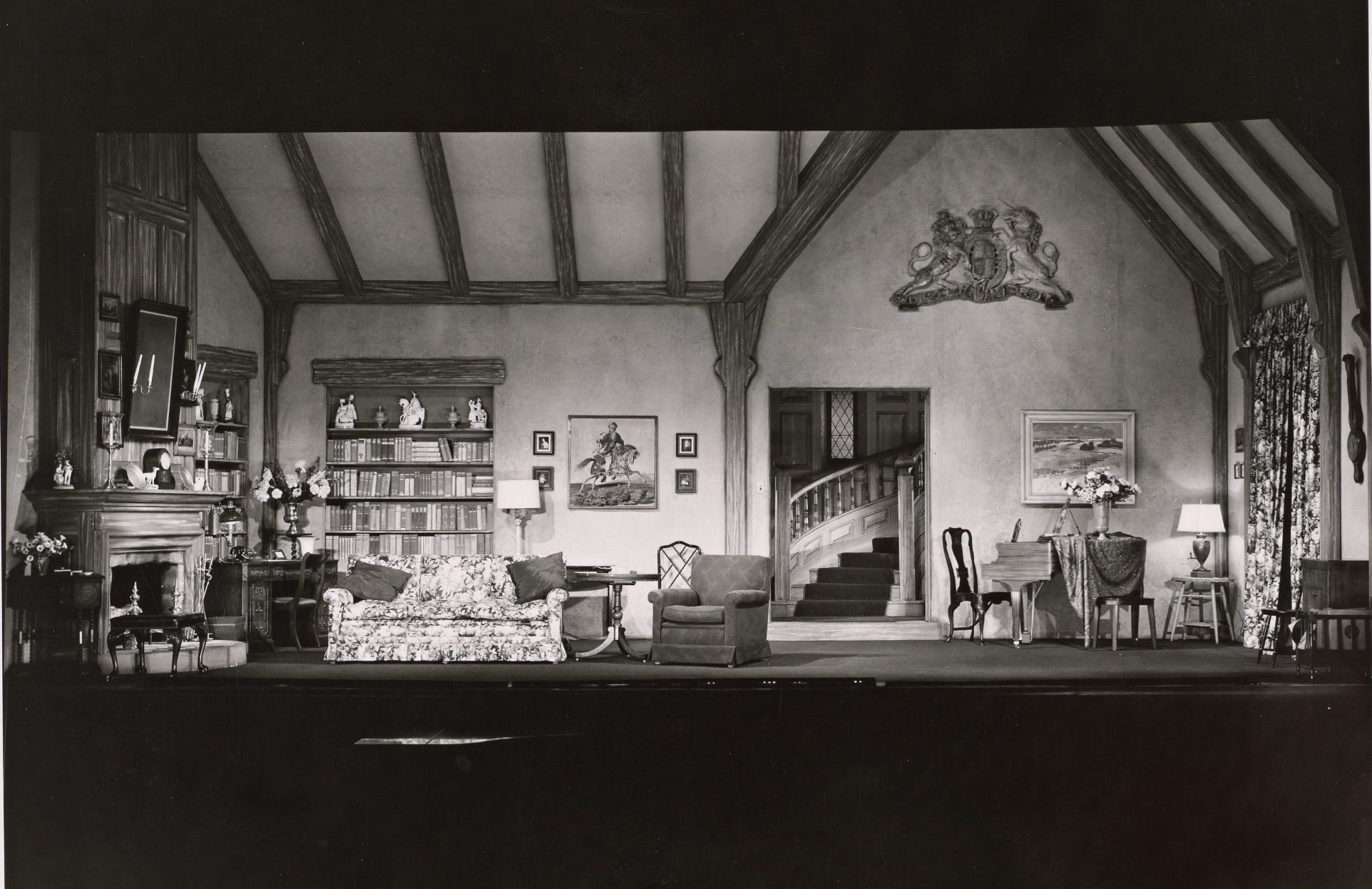
Billy Rose Theatre Division, The New York Public Library. The set of the original Broadway production of Noël Coward’s Blithe Spirit. The New York Public Library Digital Collections. 1941
Everything works towards the hard-won goal of making you feel like you’re in that living room, or kitchen, or with George and Lennie in their bunkhouse.
I’ve often thought about how set design could teach us a few things about our own sets … that is, the rooms in which we live. One is fantasy, the other reality but if you break down some of the components of creating a compelling scene, the same principles apply in creating good interior design.
Here are some of the important ones.
The budget’s the thing
Almost everything I read about set design starts with the same topic: the budget. How much money you have to work with in the production will influence literally every decision you make, big or small. “Excellent stage design simultaneously solves script, blocking and budget problems, to balance cost-effectiveness with originality,” says Jean-François Revon, a stage and video designer with more than 300 productions to his credit in opera, theatre, musicals, and ballet.
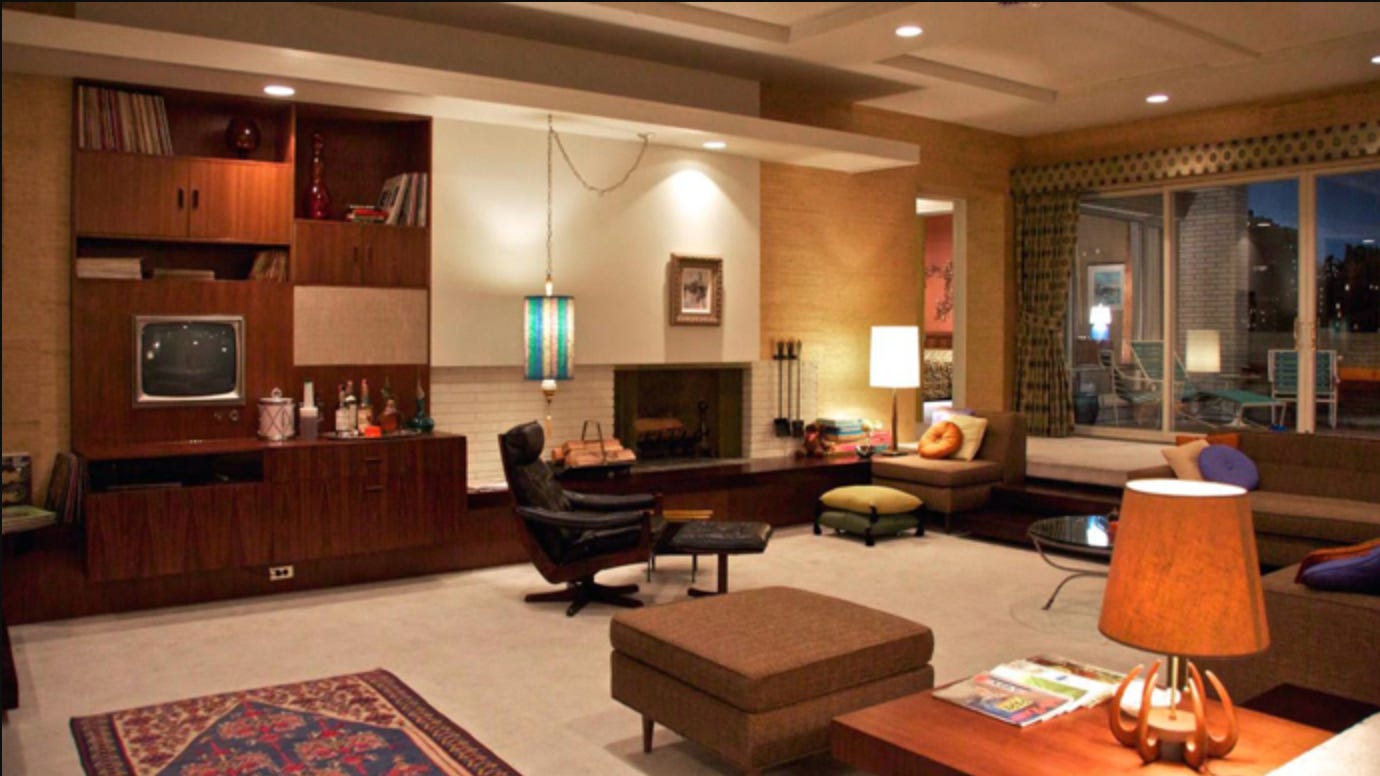
In Season 5 of Mad Men, meticulous period authenticity and set designer Christopher L. Brown’s ability to create a sunken living room brilliantly reflects Don Draper’s status as a rising 1960s ad executive. (Photo: AMC)
A budget is the tension that produces resourcefulness, creativity, and originality on your stage. You spend on the one (or two) things that don’t come cheap and that you really need. The rest is about opening your eyes to new uses and new sources. A sturdy couch can be transformed with a slipcover, or by investing in a (less expensive) armchair that brightens the sitting area.
Part of the artistry of a room is in creating luxe for less. Knowing when to spend and when to save.
Lighting is power
On stage, strategic lighting is crucial. It’s an entire industry with its own technologies, terminology, practitioners, and experts. It cannot be overestimated in the ultimate success of a film or a play.
Besides the fundamental purpose of allowing audience and actors to see what is happening (general cover), stage lighting goes further. Special lighting “spotlights” the significant, indicates who is important, and signifies the time of day or the passing of time.
Absence or diminished light evokes mood, suggests mystery or depression, and perhaps softens reality (think of how candlelight is more flattering to aging faces than bright LEDs).

In a production of The Glass Menagerie, both cool and warmly lit scenes are reflected by a pool of water that surrounds the stage. In this scene, blue, dim lighting tells the audience they are looking at past events from the protagonist Tom’s memory. (Photo: M.J. Lutch | JK’s Theatre Scene)
I can almost guarantee that none of us are 100% happy with the lighting in our rooms. Lighting is an art and it most definitely gets mishandled by the firms who build our homes. Both built-in and spot lighting is something well worth study as you think about how you use and enjoy your rooms.
There is meaning in everything
On stage, superfluousness is the enemy. To put it more positively, each object and its placement is imbued with meaning. The set designer makes a hard decision for everything: is it needed, what does it symbolize, will the actors use it, will the audience understand why it’s there, etc. The nice thing about make-believe is that the boring necessities of life can be ignored.

The backdrop here is busy and somewhat cartoonish, revealing the chaotic nature of the plot in Noises Off. Photo: Roger Moistriani for CoolCleveland.com
In real life, however, the needful must co-exist with the meaningful. Our meaningful objects are displayed prominently in our rooms. For the needful objects, we are grateful but try to hide them behind doors and drawers. Finding a balance and a place for everything is your challenge.
“Have nothing in your house that you do not know to be useful, or believe to be beautiful.”_William Morris
Basically if anything in a room catches your eye, and it’s not beautiful, or personally meaningful, then you still might have a little work to do.
Spatial manipulation
When designing a set, the stage is often divided into an odd number of parts, so that there is always a “center stage.” (The average stage is divided into a grid of nine parts.) Creating distinct areas emphasizes the different actions taking place and helps move the story forward.


This L-shaped set for a production of Of Mice and Men is built on a platform that rotates easily. One side is the exterior of a ranch bunkhouse where George and Lennie live. On the other side, the interior space is small but still has cleverly defined sleeping areas. (Photo: Jean-François Revon)
I’ve rambled on and on about zoning and creating distinct spaces in this Substack but it does bear repeating. In most cases, this is a winning strategy and honestly, most of us do it instinctively.
You don’t put your work desk on your bed.
Also, life changes. You started collecting 1960s album covers, took up needlepoint and need a well-lit spot for stitching, or you are a new parent and want a special baby area. That’s when the drama happens and you can use your innate set design skills to make your home reflect who you are, and where you are right now.
Love this! Theatrical settings can teach us so much about the power of lighting on mood and affect (the “a” is intended). 15 years ago I chose a classic wallpaper in a citrus shade, but I did not try a sample panel on my walls first. Considering it was for a room in a New England home where winter is at least 7 months long, the resulting effect was ghastly! Gorgeous pattern, but the color of stale Clorox! Lived with it for as many years as I could stand (10?) and now finally have the golden yellow rice paper that makes the room glow in every season, and at all times of the day. Invested in an ample sample (without blowing the budget) and it was well worth i!
I love this!! I’m rewatching Mad Men now and Don Draper’s apartment has converted me to a MCM lover