

Cyanotype sounds old-timey even before you manage to get the word out of your mouth. But in Claudia Hollister’s quiet, capable hands, the technique produces some of the most arresting art I’ve seen in a long time.
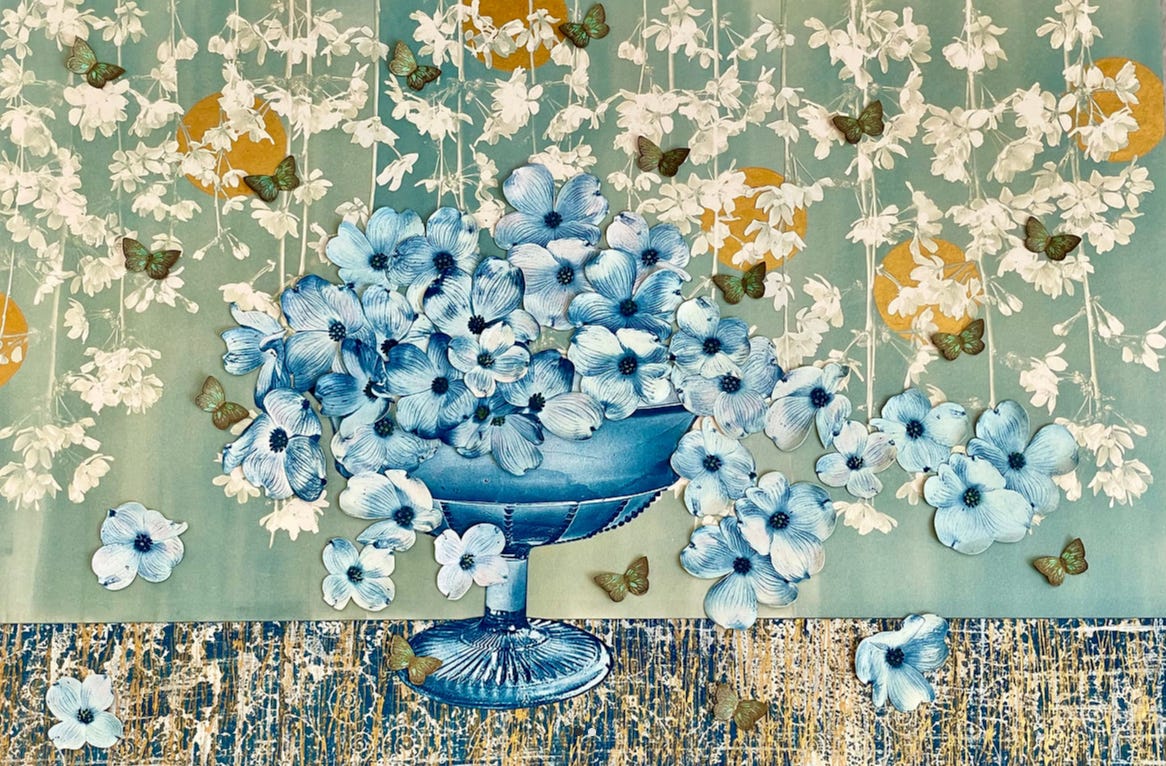
“Abundance,” collage, 20 x 30 inches; $3,000. (All photos: Claudia Hollister)
As Hollister explains, cyanotype is an historical form of photography dating back to 1842. When a light-sensitive solution is applied to paper and exposed to UV light, a chemical reaction occurs that creates beautiful shades of blue. If an object is placed on the paper (thereby blocking the light), it leaves a remarkably detailed imprint.
Cyanotype gave us the blueprint, allowing large-scale architectural drawings to be made quickly and cheaply. (A line drawing on transparent paper is placed on the treated paper and it is transferred, resulting in white lines surrounded by blue.) At the same time, botanists like Anna Atkins used cyanotype printing to capture delicate specimens of plant life.
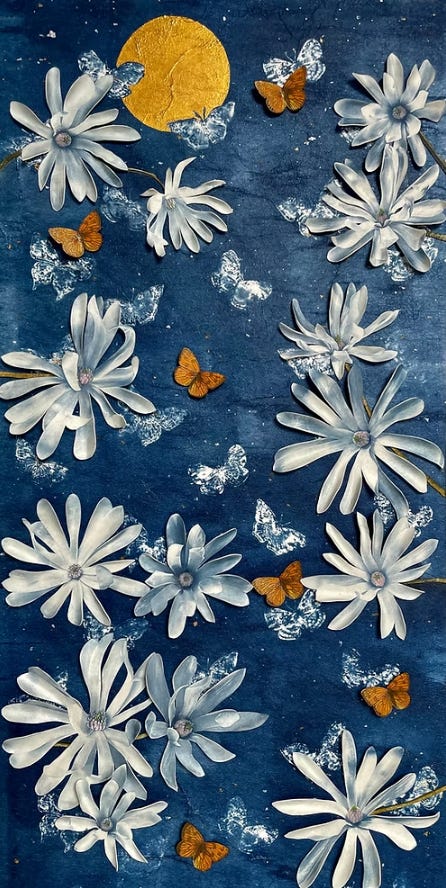
“Star Magnolias in the Moonlight,” collage, 24 x 12 inches (in a gold frame with museum glass); $1,800
It was this same nature trail that Hollister began to walk after many years working with other forms and materials. During COVID, Hollister spent hours studying the flowers and leaves in her back yard. Then she began photographing them, making multiple prints and experimenting with papers and fabrics.
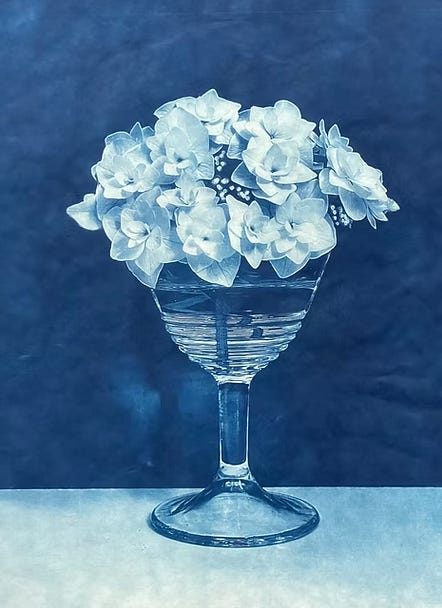
“Bridalveil Hydrangea,” print, 11 by 14 inches; $320
When she describes her process, it sounds daunting. “I photograph individual flowers and vessels, make negative transparency films, and print them repeatedly. I build backgrounds and foregrounds of different unique papers. The flowers and vessels are from delicate Sikishu paper that is backed with Stonehenge printmaking paper for structure. Each form is carefully cut, treated with three natural products, and selectively tinted.
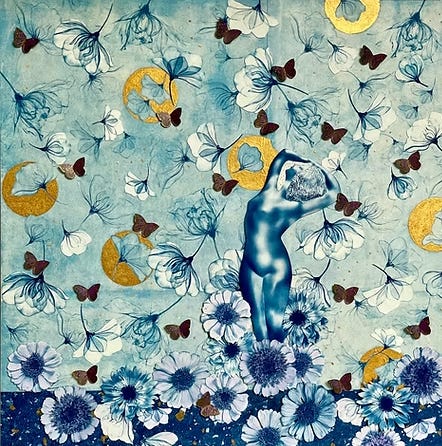
“Nymph Rising, collage, 24 by 24 inches; $2,800 (in gold frame with museum glass)
“I then explore possible arrangements, photographing each composition before settling on a final configuration. Only then do I begin shaping, gluing, and assembling.” In her encaustic works, Hollister develops a cyanotype background and then places an object in the foreground, usually a vessel, that she shapes out of beeswax.
The time and effort, along with astounding creative thought, that goes into artwork like Hollister’s reminds us of the paradox of great art: It is priceless, yet price sensitive. Few are willing (or even able) to pay the amount it would take to fairly compensate artists for their time and creative investment.
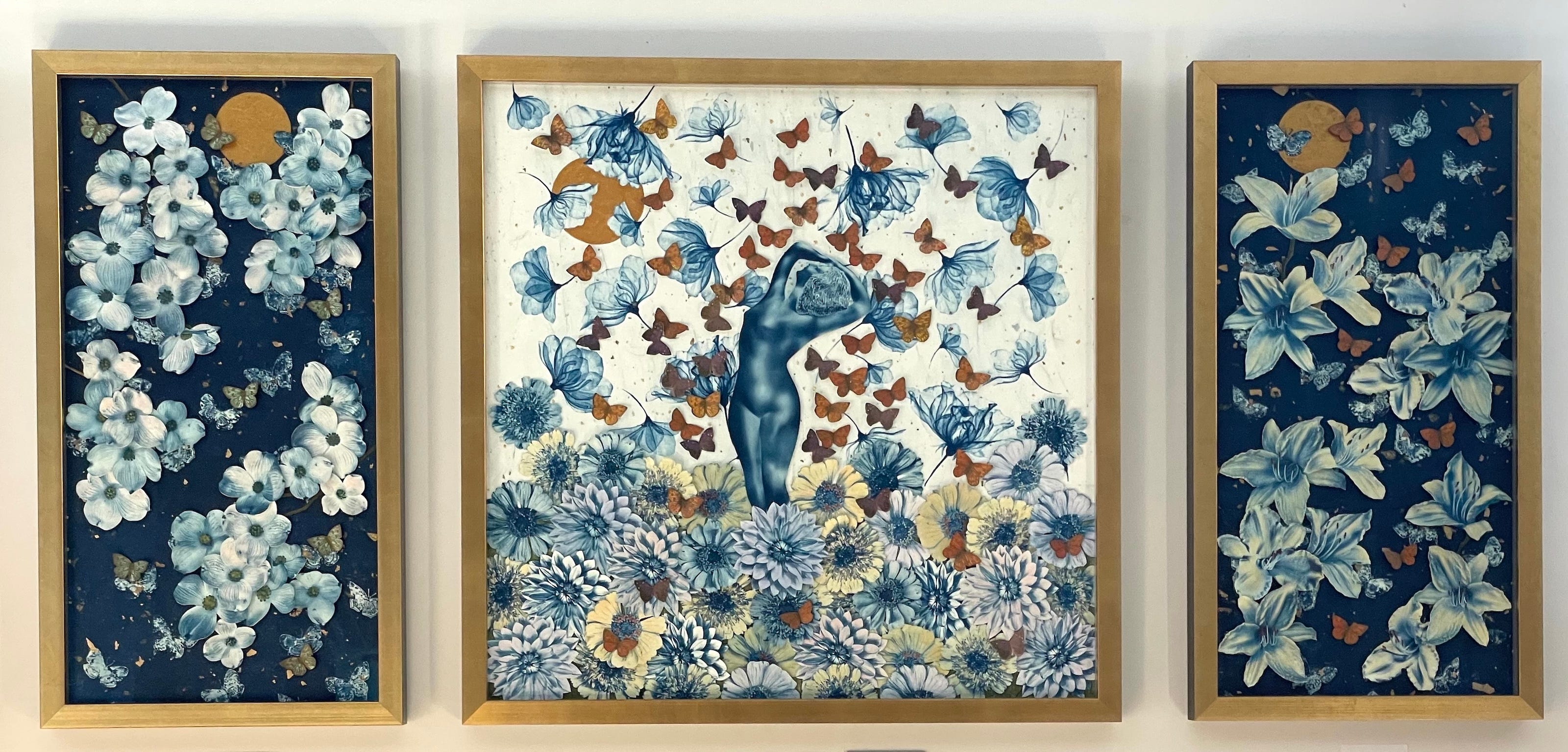
With their undulating tones of blues, whites, and golds, Hollister’s cyanotype pieces are particularly stunning in groups of three.
Hollister’s current website exhibits both prints and collages, with various price points depending upon medium and size. Most of them are finished with a simple gold frame and museum-quality glass. She has many enthusiastic clients and collectors. “People often buy one piece and then return for another,” Hollister says. She exhibits frequently and has a permanent place at Waterstone Gallery in Portland, Oregon.
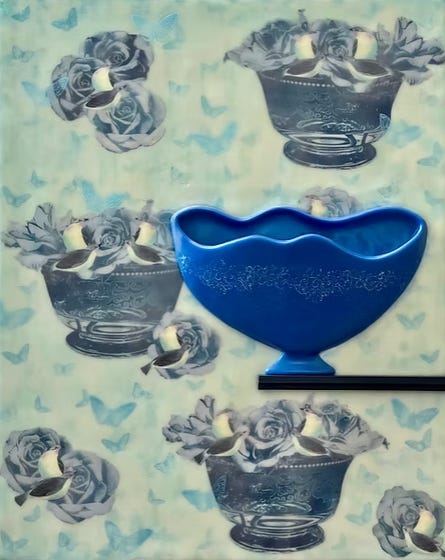
“Venetian Bowl,” encaustic painting with a dimensional bowl on a wood shelf, 20 x 16 inches; $2,300 (on cradled wood panel)
Hollister’s work is made all the more interesting by her background in silver, mold-making, and porcelain. Everything she has made in the past informs the artwork she creates now. Note the curvy vessel in her encaustic painting above; it no doubt hearkens back to her years designing teapots, sculptures, and large-scale porcelain installations. Part of the attraction to collecting art is discovering the artist’s story contained therein.
It’s there if you look for it.